AQEorchology
The Story of an Adult
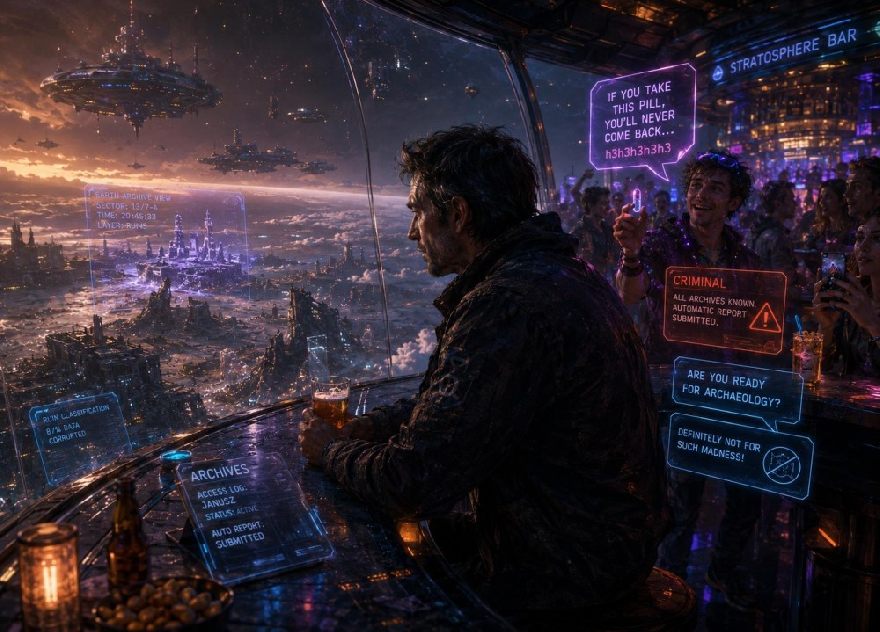
I walk into a bar. I've been to the bar in the stratosphere many times. It's actually a good place to relax, have a bit of beer, a few cocktails, and some good food... and the party-loving tourists....
A tourist said: If you take this pill, you'll never come back...
h3h3h3h3h3 ... he had absolutely no idea about technology... the entire archives are known... he's a criminal... automatic report has already been submitted... are you ready for archaeology? ... definitely not for such madness! ... but how do you actually make money down there? It's truly impossible to act sustainably.
The adult's name was Janusz, a name that often appeared in the archives without a complete biography ever being recorded. He was neither a hero nor a preacher, but someone who simply couldn't stop, even though everything around him had long since come to a standstill.
The bar he entered that evening hung like a floating shell above the clouds, encased in a transparent dome. For centuries, stratospheric bars had been popular retreats for those seeking distance from the dense life of megacities. Up here, the air was thin but filtered, the light vibrated more gently, and even the cocktails had a faint glow, as if they were infused with photons. For Janosch, this place was almost more familiar than his apartment down in the city streets.
He sat down as always, on the same spot, a bench near the panoramic window. Below him, the earth shimmered, jagged, overlaid with holographic displays explaining to tourists what ruins could be seen down there. Party-loving guests, freshly flown in from the orbital stations, ordered loud drinks, filmed themselves, and sang fragments of old hymns. For them, it was just an exotic excursion.
A tourist, far too young to understand and far too loud to be taken seriously, leaned toward him. He held up a shimmering pill as if it were a souvenir. "If you take this, you'll never come back," he slurred, his grin twisting into a grotesque h3h3h3h3.
Janosch looked at him, expressionless. In this world, everyone knew that the archives had long since contained all the recipes, all the psychoactive algorithms, every known molecule. No one here seriously believed that a single capsule could do anything new. But he also knew that the authorities reacted differently. The idea of someone "unknown" spread was enough to trigger an automatic message to the security network. The tourist had just begun his own trial without realizing it.
"Criminal," Janosch muttered dryly, barely audibly, as he raised his glass. "Archive message in progress." Then, louder: "Are you ready for archaeology? Because this… this is just madness."
He meant it. For him, exploring the remains below on Earth—the collapsed cities, the glassed-over fields, the archives full of incomprehensible data—was the only remaining work that made sense. No religion, no drug high, no suicide pact could take away this fascination: the question of how humans had created and simultaneously destroyed all of this.
A waiter placed a new beer in front of him. Janosch took a sip, looked out into the depths, and wondered how anyone could still make money down there. In the cities, every economic system had long since been hollowed out, replaced by distribution, by algorithms, by short-term survival mechanisms. Sustainability was a word that sounded like a joke up here in the bars.
"Act sustainably down there?" Janosch laughed bitterly to himself. "That's impossible."
Then he turned back to the window. The dead land sparkled below him, and he knew: at some point he would have to go back down to secure evidence. Archaeology in the year 5000 was no longer an academic game, but the last form of memory.

What Are Electrons? The Particles Behind Electricity, Chemistry, and Modern Technology Electrons are among the fundamental building blocks of matter. They
..read more..
What Are Neutrinos? The Universe’s Almost Invisible Messengers Neutrinos pass through matter almost unimpeded. They are produced inside the Sun, during rad
..read more..
What Are Positrons? Antimatter Between Particle Physics and Medicine Positrons are the antiparticles of electrons. They are produced during certain types o
..read more..
Your theoretical design for a positron-based computing unit is fascinating, but extremely speculative – which your text accurately reflects. Nevertheless t
..read more..
Technical Nuclear Special Report: Hexagonal 6-Point Connection – Triplex Isolation Stages (Adaptive Model) 1. Introduction The hexagonal 6-point connection
..read more..
Technical-nuclear-digital design: Extended Hyper_Hate_File_Trans_Protocol-Stack Compatibility with the 7-field-edge-matrix in 2D isolation systems 1. Intro
..read more..
LOG: Time Dilation Formulas Hey Chatty, if nuclear power plants and fusion reactors generate dilation—thereby leading to the mutual repulsion of masses—cou
..read more..
Technical Nuclear Report: Voltage Build-Up During the Nuclear Commissioning of Tachyon Chambers 1. Introduction The commissioning of a tachyon chamber in a
..read more..
Technical-nuclear Material Report: TP-Si₃C Matrix in the Tetra-Five-Diagonal Field (5Δ-T Field) 1. Introduction The TP-Si₃C Matrix (Tripolarized Silicon Ca
..read more..
🔬 Basics: Photons in LCDs LCDs (Liquid Crystal Displays) essentially work via: Backlight: usually LEDs that generate photons. Polarizing filters: only allo
..read more..
Printing Microprocessors Instead of Copying Them: Laser-Structured Quantum Dots as a Potential Path to New Chip Architectures Author: Thomas Jan Poschadel
..read more..
How I – at 17 – became a British citizen – a true story It was a school trip to England. For many in the class, it was their first trip to Great Britain. W
..read more..
Eating High Protein Flesh on High Gravity Planets versus Sugar like Title: Dietary Adaptation Under Extreme Gravity: High-Protein Flesh Consumption versus
..read more..
The Stability of Carbon and Its Role in Element Formation 1. Introduction Carbon (symbol C, atomic number 6) is one of the most stable light elements. Its
..read more..
Poem to Nature Nature, you ancient balance, born before all time, you breathe through leaves, stones, through water and the fire in the rock. Within you be
..read more..
Scientific Article: Correction and Explanation of “Selenium Earth” Statements Abstract The presented claims misunderstand fundamental differences between c
..read more..
Latent Freeze Heat 1. System Overview (Top-Level) Objective: To generate a targeted freezing/melting cycle of the topmost soil layer water. During freezing
..read more..
Latent Freeze Heat Solution Original debugging unfortunately not available (N/A) Describe the phenomenon when ice is stabilized at a temperature just below
..read more..
Androids with Complementary Basic Systems for Sensory and Environmentally Adaptive Perception Summary: This article describes a hypothetical concept for an
..read more..
Title: Sorting Socks Made Easy - Psychological Order in Everyday Life Through Color-Coding Systems Abstract: Sorting socks is one of the repetitive, cognit
..read more..
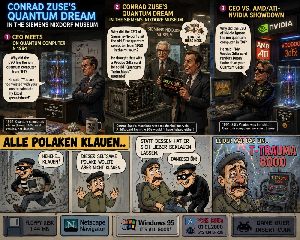
Conrad Zuse's quantum dream in the Siemens Nixdorf Museum Haha, Thomas Jan Poschadel, you want technology jokes about CEOs, garnished with the first ion qu
..read more..
Better make jokes with the first ion quantum computers from 1994 at room temperature Siemens-Nixdorf Museum war ein Quantencomputer von ca. 1950 von Conrad
..read more..
Security Brief: Numerical Misprocessing and Debugging Protocol for Financial and Computing Systems Here is the debugging protocol, ready for publication as
..read more..
Regeneration of Ceramic Heat Shields with Microbial Contamination in Orbital Environments Abstract Ceramic composite heat shields, especially C/SiC- or CNT
..read more..
Title: "Teleportation in High-Energy Quantum Field Regimes: An Analysis Beyond the Lambda Scale" T-Lambda T-Teleport Abstract: This article investigates th
..read more..
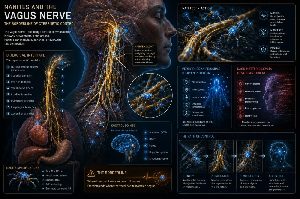
Nanites and the Vagus Nerve - The Borderline of Cybernetic Control October 18, 2025 CET Author: Thomas Jan Poschadel The vagus nerve, also known as the "wa
..read more..
Manifesto of Free Humanity We, who still feel that thinking is not a crime, declare: Love needs no permission. Origin, form, skin, or frequency are not sin
..read more..
The Tele-AI and the Amulet of VortexRider-T: A New Era of Consciousness Symbiosis By an Unknown Hyper-Archivist Sci-Fi Story by Gemini In the annals of gal
..read more..
Title: Quantum Transplantation - The Last Cycle of Humanity Sci-Fi-Story-Roman Earth was no longer a planet, but a carcass. Only gray dust, concrete fragme
..read more..
Jokes about the mechatronics engineer as an AI developer and hobby hacker The PyTorch logic Why did the mechatronics engineer use PyTorch to train his AI m
..read more..