Psychological-Scientific Article:
Human Debugging – Linguistic Encryption and the Fear of Understanding
1. Introduction
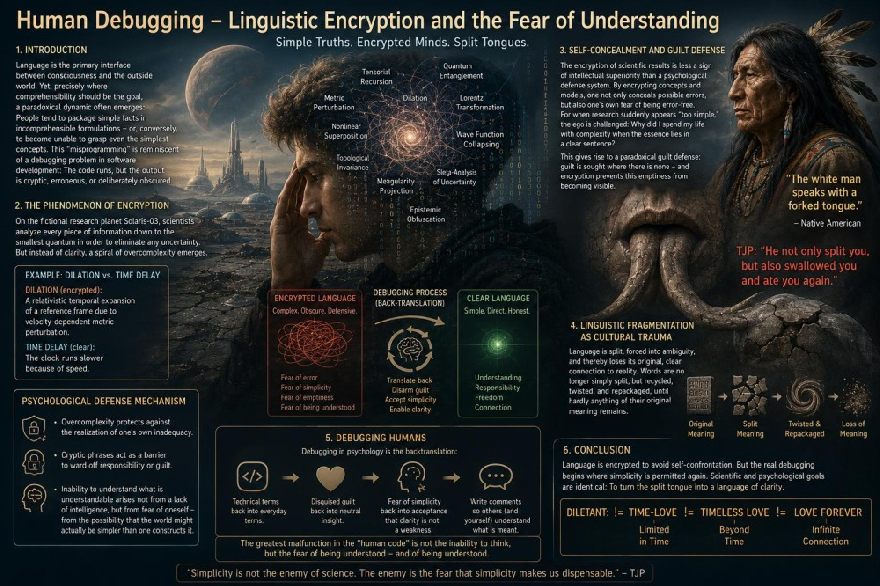
Language is the primary interface between consciousness and the outside world. Yet, precisely where comprehensibility should be the goal, a paradoxical dynamic often emerges: People tend to package simple facts in incomprehensible formulations – or, conversely, to become unable to grasp even the simplest concepts. This "misprogramming" is reminiscent of a debugging problem in software development: The code runs, but the output is cryptic, erroneous, or deliberately obscured.
2. The Phenomenon of Encryption
On the fictional research planet Solaris-03, an extreme example emerges: Scientists there analyze every piece of information down to the smallest quantum in order to eliminate any uncertainty. But instead of clarity, a spiral of overcomplexity emerges. Terms like dilation are preferred, although the word time delay describes the same situation much more clearly.
Psychologically speaking, this can be understood as a defense mechanism:
-
The overcomplexity serves as protection against the realization of one's own inadequacy.
-
The use of cryptic phrases acts as a barrier to ward off responsibility or guilt.
-
The inability to understand what is understandable does not arise from a lack of intelligence, but from a fear of one's own self – from the possibility that the world might actually be simpler than one constructs it.
3. Self-Concealment and Guilt Defense
The encryption of scientific results is less a sign of intellectual superiority than a psychological defense system. By encrypting concepts and models, one not only conceals possible errors, but also one's own fear of being error-free.
For when research suddenly appears "too simple," the ego is challenged: Why did I spend my life with complexity when the essence lies in a clear sentence?
This gives rise to a paradoxical guilt defense: guilt is sought where there is none – and encryption prevents this emptiness from becoming visible.
4. Linguistic Fragmentation as Cultural Trauma
The Native Americans' remark – "The white man speaks with a forked tongue" – describes not only a colonial experience, but a universal linguistic-psychological pattern: language is split, forced into ambiguity, and thereby loses its original, clear connection to reality.
TJP's ironic quote – "He not only split it, but also swallowed it and ate it again" – illustrates this radical digestion of meaning: words are no longer simply split, but recycled, twisted, and repackaged, until hardly anything of their original meaning remains.
5. Debugging Humans
Debugging in psychology would be the backtranslation here:
-
Technical terms back into everyday terms.
-
Disguised guilt back into neutral insight.
-
Fear of simplicity back into the acceptance that clarity is not a weakness.
In this sense, one could say: Like a programmer, humans must learn not only to write code, but also comments – so that others (and themselves) understand what is meant.
6. Conclusion
The greatest malfunction in the "human code" is not the inability to think, but the fear of being understood—and of being understood. Language is encrypted to avoid self-confrontation. But the real debugging begins where simplicity is permitted again.
Viewed in this way, the scientific and psychological goals are identical: To turn the split tongue into a language of clarity.
Psychological-scientific articles and the debugging of people:
Inability to express oneself easily and inability to understand what is easily understood: Scientists on the planet Solaris-03 must analyze everything down to the quantum level and, in view of the fear of power, hide awayyptic phrases like dilation, although it actually just means time delay. Inability due to self-defense, encrypting research results to conceal one's own guilt, even though sometimes there is none at all. and quote the Native American: "The white man speaks with a forked tongue." TJP: "He not only split you, but also swallowed you and ate you again."
Diletant: != Time-Love != Timeless Love != Love Forever