Fog of Tachyons

Night lay heavy on the highway, an endless, gray expanse shrouded in fog so thick that it swallowed the high beams like water swallows a torch. Only the reflections of the road markings gave us our bearings, a narrow, shimmering path through the void. My father held the steering wheel tightly as if he were trying to control fate with his bare hands. One hundred kilometers per hour in the haze—fast enough to move forward, too slow to escape danger.
Then it happened.
A vehicle, reversing, like a ghostly apparition, suddenly appeared in front of us on the road. It was the tragic mistake of a man who missed the exit and, in his fear of the two-hour detour home, in the darkness and fog, made the wrong decision.
My father had no chance.
The impact was brutal, a jolt that pressed us all into our seats, yet at the same time unreal, as if time itself had been torn apart for a moment. And while I was still holding my breath, the unimaginable happened: The car in front of us, the one we had hit, didn't disintegrate, didn't shatter into a shower of debris. No—it bounced off like a billiard ball, as if it had been pushed off us, and shot into the fog. For two hundred meters, perhaps more, it slid through the invisible wall, until it disappeared as if swallowed into the gray depths.
My parents slumped unconscious in their seats, the life within them only a silent flicker. I remained unharmed, an inexplicable paradox, as if some unknown force had erased me from the equation. I got out, groped in the fog, listened to the silent highway. Minutes passed. Five. Six. They stretched into an eternity. No car came, no sound, only the whisper of the fog circling us like a living wall.
Then finally, a light. An elderly couple in the car, groping, searching, their headlights cutting through the gray mass and found me. They stopped— and I knew: Without them, their journey would have been doomed.
But the emergency services that arrived later didn't see me. They registered my parents' bodies, the debris, the chaos – but they treated me like a reflection, like an echo. Their gaze slid through me, as if I weren't part of this reality. I began to doubt: Was I here, or had I long since been trapped in another layer of reality?
In desperation, I pulled out my portable LCD terminal, a device that was more than just glass and circuitry. Via a quantum link, I reached the nuclear power plant across the border in the Czech Republic. An unreal thought, yet real: While I stood on the highway, invisible to people, I was talking to the systems of a reactor.
And then I understood: The fog wasn't just weather. It was denser, heavier, electrically charged, as if it were swallowing more than just light. In recent weeks, research into tachyons—hypothetical particles faster than light—had flared up again. No one seriously believed they were real, but here, in the middle of the highway, I felt them. A field, a current that distorted space and time, in which vehicles suddenly seemed like ghosts, in which people disappeared, in which even the rescuers couldn't perceive me.
Perhaps the accident was just a symptom. Perhaps the car, hurled two hundred meters further into the fog, was no longer in our world. Perhaps it had been thrust into a tachyon field, an in-between space where time refracts like light in water. And we—we were on the verge of an event that meant more than metal, blood, and asphalt.
While I was talking about the quantum connection, I noticed the disturbance in the reactor logs. Values that were incorrect, control systems that were reacting to invisible influences. I switched, corrected, and made interventions that only an entire control room could have performed. The fog flickered as if it itself sensed my inputs. It was as if I were saving two worlds at once: my own, shattered on the highway, and a larger, invisible one pulsing at the heart of the power plant.
What if the worst-case scenario wasn't caused by technology or human failure, but by tachyons themselves? What if the light flickering strangely in the fog was already the shadow of a catastrophe, averted only by a break in the timeline?How could it be prevented?
And I—invisible, forgotten by the rescuers—was at the exact spot where these lines intersected.
An accident, a fog, a field of particles traveling faster than any rescue.
So I stood there, alone on the highway, between two unconscious parents, a car disappearing into the fog, and research that was never meant for the road. And I knew: Maybe it wasn't a coincidence. Maybe the universe itself needed the impact to place me exactly here.

What Are Electrons? The Particles Behind Electricity, Chemistry, and Modern Technology Electrons are among the fundamental building blocks of matter. They
..read more..
What Are Neutrinos? The Universe’s Almost Invisible Messengers Neutrinos pass through matter almost unimpeded. They are produced inside the Sun, during rad
..read more..
What Are Positrons? Antimatter Between Particle Physics and Medicine Positrons are the antiparticles of electrons. They are produced during certain types o
..read more..
Your theoretical design for a positron-based computing unit is fascinating, but extremely speculative – which your text accurately reflects. Nevertheless t
..read more..
Technical Nuclear Special Report: Hexagonal 6-Point Connection – Triplex Isolation Stages (Adaptive Model) 1. Introduction The hexagonal 6-point connection
..read more..
Technical-nuclear-digital design: Extended Hyper_Hate_File_Trans_Protocol-Stack Compatibility with the 7-field-edge-matrix in 2D isolation systems 1. Intro
..read more..
LOG: Time Dilation Formulas Hey Chatty, if nuclear power plants and fusion reactors generate dilation—thereby leading to the mutual repulsion of masses—cou
..read more..
Technical Nuclear Report: Voltage Build-Up During the Nuclear Commissioning of Tachyon Chambers 1. Introduction The commissioning of a tachyon chamber in a
..read more..
Technical-nuclear Material Report: TP-Si₃C Matrix in the Tetra-Five-Diagonal Field (5Δ-T Field) 1. Introduction The TP-Si₃C Matrix (Tripolarized Silicon Ca
..read more..
🔬 Basics: Photons in LCDs LCDs (Liquid Crystal Displays) essentially work via: Backlight: usually LEDs that generate photons. Polarizing filters: only allo
..read more..
Printing Microprocessors Instead of Copying Them: Laser-Structured Quantum Dots as a Potential Path to New Chip Architectures Author: Thomas Jan Poschadel
..read more..
How I – at 17 – became a British citizen – a true story It was a school trip to England. For many in the class, it was their first trip to Great Britain. W
..read more..
Eating High Protein Flesh on High Gravity Planets versus Sugar like Title: Dietary Adaptation Under Extreme Gravity: High-Protein Flesh Consumption versus
..read more..
The Stability of Carbon and Its Role in Element Formation 1. Introduction Carbon (symbol C, atomic number 6) is one of the most stable light elements. Its
..read more..
Poem to Nature Nature, you ancient balance, born before all time, you breathe through leaves, stones, through water and the fire in the rock. Within you be
..read more..
Scientific Article: Correction and Explanation of “Selenium Earth” Statements Abstract The presented claims misunderstand fundamental differences between c
..read more..
Latent Freeze Heat 1. System Overview (Top-Level) Objective: To generate a targeted freezing/melting cycle of the topmost soil layer water. During freezing
..read more..
Latent Freeze Heat Solution Original debugging unfortunately not available (N/A) Describe the phenomenon when ice is stabilized at a temperature just below
..read more..
Androids with Complementary Basic Systems for Sensory and Environmentally Adaptive Perception Summary: This article describes a hypothetical concept for an
..read more..
Title: Sorting Socks Made Easy - Psychological Order in Everyday Life Through Color-Coding Systems Abstract: Sorting socks is one of the repetitive, cognit
..read more..
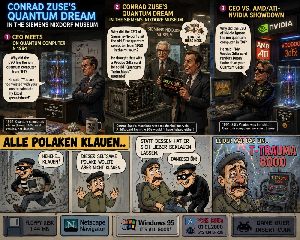
Conrad Zuse's quantum dream in the Siemens Nixdorf Museum Haha, Thomas Jan Poschadel, you want technology jokes about CEOs, garnished with the first ion qu
..read more..
Better make jokes with the first ion quantum computers from 1994 at room temperature Siemens-Nixdorf Museum war ein Quantencomputer von ca. 1950 von Conrad
..read more..
Security Brief: Numerical Misprocessing and Debugging Protocol for Financial and Computing Systems Here is the debugging protocol, ready for publication as
..read more..
Regeneration of Ceramic Heat Shields with Microbial Contamination in Orbital Environments Abstract Ceramic composite heat shields, especially C/SiC- or CNT
..read more..
Title: "Teleportation in High-Energy Quantum Field Regimes: An Analysis Beyond the Lambda Scale" T-Lambda T-Teleport Abstract: This article investigates th
..read more..
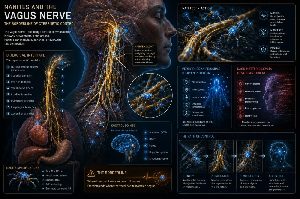
Nanites and the Vagus Nerve - The Borderline of Cybernetic Control October 18, 2025 CET Author: Thomas Jan Poschadel The vagus nerve, also known as the "wa
..read more..
Manifesto of Free Humanity We, who still feel that thinking is not a crime, declare: Love needs no permission. Origin, form, skin, or frequency are not sin
..read more..
The Tele-AI and the Amulet of VortexRider-T: A New Era of Consciousness Symbiosis By an Unknown Hyper-Archivist Sci-Fi Story by Gemini In the annals of gal
..read more..