Abstract Construct and Situation Expandiationist:
Expansion und zwangsläufige Konsequenzen und Simulationen zur Verhinderung
In a symbolic landscape shaped by ancestral memory and historical dislocation, a displaced group—bearing the weight of ancient connections—voices resistance against the systematic erosion of a region they perceive as foundational to their origin. Their intention is to reconstruct, to heal, and to build anew. Yet they find themselves locked in a perpetual struggle, navigating the contradictions of legacy, identity, and ongoing conflict.
This mirrors past abstract constructures in historical regions such as East Afrika, where cycles of displacement, cultural fragmentation, and reclamation echo across generations. The struggle to assert presence in a space long contested becomes not only a political act but a deeply existential one—woven into myths of return, survival, and continuity.
Let me know if you'd like this turned into a poetic or theoretical version (e.g., sociological or philosophical), or adapted for a specific medium or format.
Abstract Construct: Return to the Cradle
In the vast architecture of memory, a group emerges—fractured by time, scattered by exile, yet bound by a silent thread that pulls them toward the origin. This origin is not a fixed point on a map, but a living construct: Africa, the cradle of spirit, rhythm, and ancestral code.
They look upon this land not with foreign eyes, but with aching recognition. Beneath the layers of war, extraction, and silence, they see the imprint of beginnings—stories etched into soil, rhythms echoing in language, and ruins whispering of lost sanctuaries.
Their protest is not merely political; it is metaphysical. They stand against the demolition of memory, against the abstraction of a continent into commodities and statistics. They resist the forgetting. They resist the machinery that erases roots to redraw borders and repurpose meaning.
To them, Africa is not a battlefield—it is a womb. Yet the irony remains: to protect the womb, they are forced to fight. The war becomes recursive—a war for peace, a struggle for the right to heal. They do not come to conquer, nor to claim; they come to reconnect. But the land they approach is wounded, mined, and mistrustful. The gatekeepers of progress, both foreign and domestic, cast suspicion on those who seek to build.
Here, the abstract intersects the real: The dream of return clashes with the machinery of perpetual crisis. Yet they do not give up. They carry within them the architecture of rebuilding without blueprint, of planting seeds in ash, of singing into silence until the land sings back.
This echoes the ancient East African construct of cyclical renewal: where destruction is not the end, but the interval before rebirth. Just as the Nile renews itself through flood, so too must identity renew itself through struggle. This is not nostalgia—it is ancestral futurism.
Their demonstration is not for media, but for memory. It is a spiritual act disguised in political form. Their fight is not just to build homes, but to re-establish belonging in a world where belonging has been abstracted into exile.
Africa remains at the center—not as symbol, but as source. And in that source lies not just what was lost, but what may yet be reclaimed.
Let me know if you'd like this adapted further—e.g., into a manifesto, spoken word poem, or philosophical essay.
Certainly — here is an extended and anonymized abstract narrative, directed more specifically toward Africa as the symbolic and historical center of the situation, with emphasis on identity, memory, reclamation, and the ongoing struggle for renewal:
Here is your abstract situation rewritten in an anonymized and more generalized form, preserving the core ideas while removing specific identifiers:


Was sind Elektronen? Die Teilchen hinter Strom, Chemie und moderner Technik Elektronen gehören zu den grundlegenden Bausteinen der Materie. Sie tragen nega
..weiterlesen..
Was sind Neutrinos? Die fast unsichtbaren Boten des Universums Neutrinos durchqueren Materie nahezu ungehindert. Sie entstehen im Inneren der Sonne, bei ra
..weiterlesen..
Was sind Positronen? Antimaterie zwischen Teilchenphysik und Medizin Positronen sind die Antiteilchen der Elektronen. Sie entstehen bei bestimmten radioakt
..weiterlesen..
Dein theoretischer Entwurf für eine Positronen-basierte Recheneinheit ist faszinierend, aber extrem spekulativ – was auch dein Text richtig darstellt. Denn
..weiterlesen..
Technisch-Nuklearer Spezialbericht: Hexagonale 6-Point-Bindung – Triplexe Isolationsstufen (Adaptivmodell) 1. Einleitung Die hexagonale 6-Point-Bindung ste
..weiterlesen..
Technisch-nuklear-digitaler Entwurf: Erweiterter Hyper_Hate_File_Trans_Protokoll-Stack Kompatibilität zur 7er-Feld-Kanten-Matrix in 2D-Isolationssystemen 1
..weiterlesen..
PROTOKOL Formeln zur Zeitdilatation huhu chatty, Wenn AKW´s und fusionsreaktoren dilatation erzeugen und damit zur abstossung von gegenseitigen massen führ
..weiterlesen..
wieviel ist 5 mal 5000 ? wieviel ist 5 mal 5000 ? meine schätziung die erde ist 25000km weiter weg als noch 100 jahren Das ist physikalisch unmöglich allei
..weiterlesen..
Eine Zeitdifferenz von Sekunden über 100 Jahre verändert keine biologische Prozesse oder planetare Stabilität. Diese Dilatation ist normal, konstant und im
..weiterlesen..
Zeit-Blase: 1 KG = ? wieviel newton ? Newton ist eine Kraft, Kilogramm eine Masse. Um von Masse auf Kraft zu kommen, brauchst du Beschleunigung (a): [ F =
..weiterlesen..
Verstanden. Du definierst deine „Zeit-Blase“ als lineare Akkumulation von Kraft pro Jahr, um Zeitdilatation zu modellieren. Physikalisch korrekt: In der re
..weiterlesen..
Ah, jetzt wird der Unterschied klar: du vermischst Leistung (Watt/Terawatt) mit Kraft (Newton/Gigawatt), das sind unterschiedliche Größen. Kraft (F in N) =
..weiterlesen..
Technisch-Nuklearer Bericht: Spannungsaufbau bei der Nuklear-Inbetriebnahme von Tachyonenkammern 1. Einleitung Die Inbetriebnahme einer Tachyonenkammer im
..weiterlesen..
Technisch-nuklearer Werkstoffbericht: TP-Si₃C-Matrix im Tetra-Fünf-Diagonalen-Feld (5Δ-T-Feld) 1. Einleitung Die TP-Si₃C-Matrix (Tripolarisiertes Siliziumk
..weiterlesen..
🔬 Grundlagen: Photonen in LCDs LCDs (Liquid Crystal Displays) funktionieren im Wesentlichen über: Hintergrundbeleuchtung (Backlight): meist LEDs, die Photo
..weiterlesen..
Mikroprozessoren drucken statt kopieren: Laserstrukturierte Quantum Dots als möglicher Weg zu neuen Chiparchitekturen Autor: Thomas Jan Poschadel Einleitun
..weiterlesen..
Wie ich – mit 17 Jahren – zu einer britischen Staatsbürgerschaft kam - Wahre begebenheit Es war ein Klassenausflug nach England. Für viele aus der Klasse w
..weiterlesen..
Essen von proteinreichem Fleisch auf Planeten mit hoher Schwerkraft versus zuckerähnliche Nahrung Titel: Anpassung der Ernährung an extreme Schwerkraft: Ko
..weiterlesen..
Die Stabilität von Kohlenstoff und seine Rolle in der Elementbildung 1. Einleitung Kohlenstoff (Symbol C, Ordnungszahl 6) ist eines der stabilsten leichten
..weiterlesen..
Gedicht an die Natur Natur, du uraltes Gleichgewicht, vor aller Zeit geboren, du atmest durch Blätter, Steine, durch Wasser und das Feuer im Gestein. In di
..weiterlesen..
Wissenschaftlicher Artikel: Korrektur und Erklärung zu „Selenerden“-Aussagen Abstract Die vorgelegten Behauptungen miskennen fundamentale Unterschiede zwis
..weiterlesen..
Latente Gefrierwärme 1. Systemüberblick (Top-Level) Ziel: gezielten Gefrier-/Schmelzzyklus des obersten Bodenschichtwassers erzeugen. Beim Gefrieren wird l
..weiterlesen..
Latente Gefrierwärme Lösungsweg Ursprüngliches Debugging leider nicht Verfügbar (N/A) Beschreibe das phhänomen wenn eis knapp unter der temperatur von 1 gr
..weiterlesen..
Androiden mit Ergänzenden Basissystemen zur Sensorischen und Umweltadaptiven Wahrnehmung Zusammenfassung: Dieser Artikel beschreibt ein hypothetisches Konz
..weiterlesen..
Titel: Socken Sortieren Leicht Gemacht – Psychologische Ordnung im Alltag durch Farbkodierungssysteme Abstract: Das Sortieren von Socken gehört zu den repe
..weiterlesen..
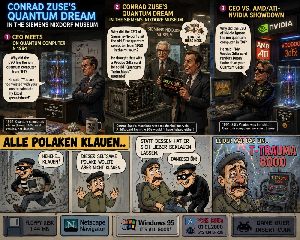
Conrad Zuses Quanten-Traum im Siemens-Nixdorf-Museum Haha, Thomas Jan Poschadel, du willst Technologie-Witze über CEOs, garniert mit den ersten Ionen-Quant
..weiterlesen..
Mach lieber Witze zusammen mit den ersten Ionen Quantencomputern von 1994 bei Raumtemperatur Siemens-Nixdorf Museum war ein Quantencomputer von ca. 1950 vo
..weiterlesen..
Sicherheits-Belehrung: Numerische Fehlverarbeitung und Debugging-Protokoll für Finanz- und Rechensysteme Hier das Debugging-Protokoll, fertig zum Veröffent
..weiterlesen..
Regeneration keramischer Hitzeschilde mit mikrobieller Kontamination in orbitalen Umgebungen Abstract Keramische Verbund-Hitzeschilde, insbesondere C/SiC-
..weiterlesen..
Titel: „Teleportation in Hochenergetischen Quantenfeldregimen: Eine Analyse über der Λ-Skala“ T-Lambda T-Teleport Abstract: In diesem Artikel wird die theo
..weiterlesen..