The conventional quantum computer as a last resort

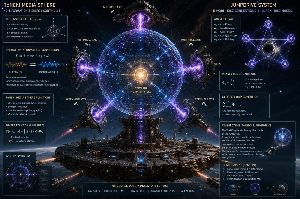
In this image, a conventional quantum computer works not only with qubits, but with humanoid structures arranged as psychic subjects in a "virtual psychiatric ward." Each of these subjects embodies a qubit that not only oscillates between "0" and "1," but is in a state of free thought—a state of "free thought." Superposition, blurriness, multi-value.
The Role of the Free Lepton
The free lepton (electron, muon, neutrino) is the carrier medium of free will.
-
In physics: Leptons interact only weakly or electromagnetically, can move freely through matter, and do not form rigid bonds.
In the image: They represent the uncaged freedom of thought processes. Just as electrons migrate through fields, thoughts migrate through the "cells" of virtual psychiatry—the "cells" of virtual psychiatry. free, unstable, barely controllable.
The lepton is thus the essence of independence: no military structure, no neural grid can completely hold it in place.
Proton formation and repulsion reactions
In this metaphor, protons act like the structural building blocks of order: stable, heavy, centered.
-
Where proton formation occurs, fixed positions, identities, role models emerge - the order of a psychiatric "institution."
-
At the same time, repulsive reactions occur: like positively charged protons that repel each other, each fixed identity creates friction and conflict with the other fixed roles.
The system thus oscillates between stability and chaos – just as a quantum computer oscillates between superposition and decoherence.
Freedom of the Subjects
Every subject possesses free will – their qubit cannot be completely determined. Even if military patterns (discipline, chains of command, reaction patterns) are deeply ingrained in the neuronal structures, the free lepton fraction remains active in the brain.
-
It is the disruptive factor in the system.
-
But it also guarantees backup diversity: no test subject will choose exactly the same solution, and thus the overall system can achieve more than a rigid, deterministic network.
Military Structures in the Brain
Humanity bears—so the metaphor goes— Archaic military patterns in the deep layers of the nervous system: fight or flight, hierarchy, territoriality. They act like default algorithms, burned in for millennia.
-
In the quantum computer model, these would be the standard gates that every test subject possesses from birth.
-
But this basic military grid is repeatedly broken by free leptons (unpredictable thought impulses).
The backup system thus thrives on the tension between ingrained drill and intangible freedom.
Kesimpulan – Bagaimana Cara Kerjanya
Sebuah komputer kuantum konvensional dengan struktur humanoid sebagai cadangan berfungsi seperti psikiatri tingkat kuantum:
-
Kubit = subjek dengan pemikiran bebas
-
Lepton bebas = impuls kehendak yang tidak terkendali
-
Pembentukan proton = stabil, namun penuh konflik peran
-
Reaksi tolak menolak = ketegangan sosial yang menjaga sistem tetap bergerak
-
Struktur militer = pola default neural yang sangat terpendam
Hasilnya: Cadangan umat manusia yang tidak hanya menyimpan operasi komputasi, tetapi struktur hidup, kontradiktif, bebas yang tidak memungkinkan kontrol absolut—dan tepat untuk alasan ini muncul tak hancur.
Lepton bebas sebagai wanita humanoid—jalur berjalan
Bayangkan lepton bebas sekarang menjadi seorang wanita humanoid yang berkelana melalui dunia kompleks, setengah nyata, setengah virtual. Gerakan-gerakannya mencerminkan sifat fisik lepton: kebebasan, kemandirian, dan sedikit korelasi dengan lingkungannya.
1. Gerakan Awal - Superposisi
Dia berdiri di sebuah ruangan penuh pintu dan jalur—semua kemungkinan ada secara bersamaan.
-
Dia belum memutuskan jalur tertentu.
-
Setiap langkah tidak ditentukan, melainkan superposisi dari kemungkinan.
-
Dari segi fisik: Probabilitas dia memasuki koridor tertentu belum tetap—dia “mengambang” di antara opsi-opsinya.
2. Terowongan Interaksi
Seringkali ia harus melewati area di mana proton atau tubuh lain menolakinya.
-
Tunel-tunelnya sempit, seperti medan elektromagnetik yang memblokir atau mengalihkan jalurnya.
-
Ia menghindar, menemukan rute alternatif, terkadang tersandung – ini sesuai dengan reaksi tolak yang dialami lepton.
3. Resonance Chambers – Gerakan Koheren
Di beberapa aula atau ruangan, ia dapat menyinkronkan gerakan: dengan cahaya, getaran, atau lepton bebas lainnya.
-
Di sini ia menari seolah-olah dalam permainan koordinasi kuantum – pola kecil dan elegan muncul yang tetap stabil sementara.
-
Secara fisik: keadaan koheren di mana lepton bertindak lebih sedikit secara acak.
4. Pertemuan – Pilihan Bebas
On her journey, she encounters other humanoid structures (protons, neutrons, other qubit subjects).
-
She can approach or repel – no collision is predetermined.
-
Every encounter tests her free will, forcing her to make decisions.
-
This reflects the free will in the system: interactions are neither deterministic nor completely controllable.
5. Open Spaces – Unfolding Freedom
In open spaces, it can move almost unhindered: jumping, turning, flying, accelerating.
-
These moments are the essence of the free lepton: maximum freedom, maximum flexibility.
-
Every movement leaves slight ripples in the environment – like a quantum pulse that influences other states without directly controlling them.
6. Decoherence – the end of the path
Sometimes she loses her clear direction, is influenced by the environment, and collides with solid structures (proton formations).
-
Then she must find new paths—the system remains dynamic.
-
In a backup system, this means: even if everything else is rigid and militarized, the free lepton ensures that no movement is definitively fixed.
Pictorial summary:
The humanoid woman (free lepton) does not move linearly, but rather fluidly, dancing, and evasively. Her paths are overlaps, detours, encounters, free decisions that constantly interact with the environment but are never completely bound. She is the agent of freedom in an otherwise highly structured, militarily conditioned system.